
.
Before Star Wars, There Was Steel: The Birth of Sci-Fi Noir
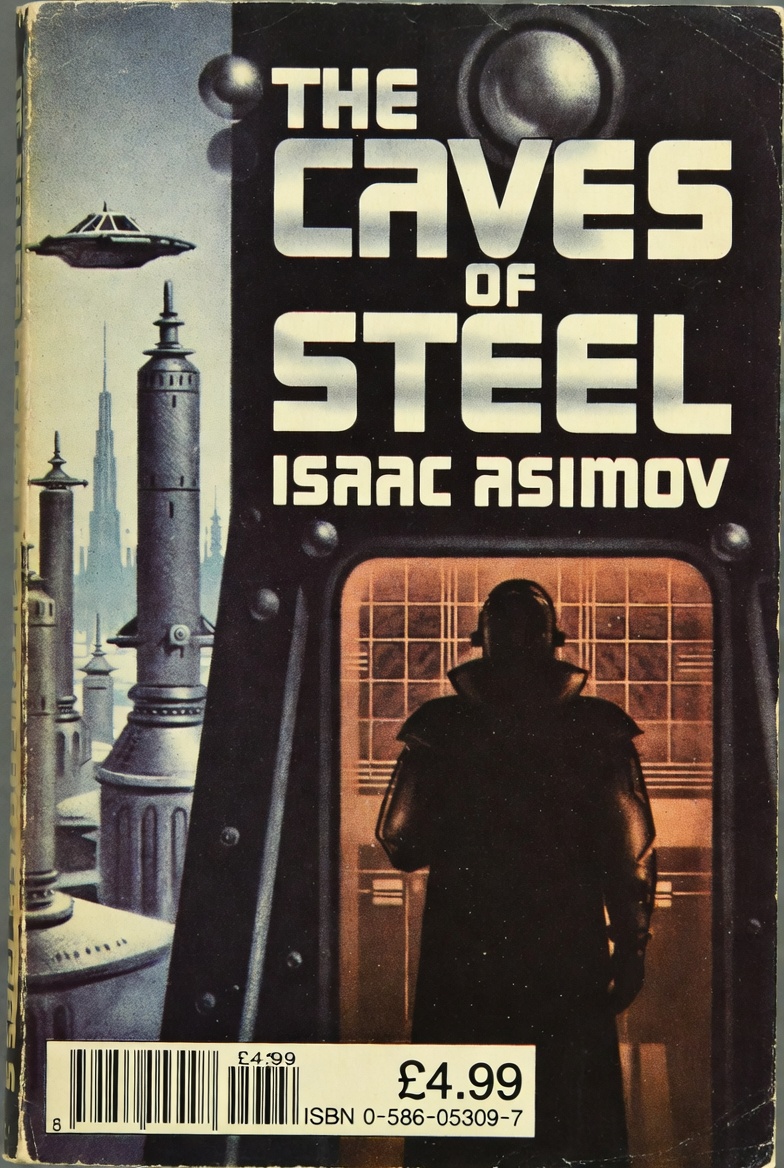
In 1954, the future was a blank slate. There was no Star Wars, no 2001: A Space Odyssey, and no moon landing. Instead, Americans were transfixed by a new screen in their living rooms: TV ownership had just exploded from 33% to over 50%. The nation was transitioning from the Truman era to Eisenhower’s consumer boom, while mega-corporations like GM and GE dominated Wall Street. Against this backdrop of rapid change, a biochemistry professor at the Boston Faculty of Medicine set out to do the impossible.
Isaac Asimov was already famous for his Foundation trilogy -which famously beat The Lord of the Rings for a one-time 1966 Hugo Award. However, critics claimed you couldn't mix science fiction with a whodunit mystery, arguing that futuristic gadgets would make a fair investigation impossible. Challenged by his publisher, Asimov proved them wrong in a furious, six-month burst of writing between November 1952 and May 1953.
The result was The Caves of Steel, a tight, 224-page masterpiece that birthed the sci-fi detective genre. The novel is a time capsule of 1950s anxieties. Asimov, a proud claustrophile, used his love for enclosed spaces to build a world where humanity lives in massive, domed underground cities. This subterranean setting perfectly mirrored the postwar urbanization and Cold War paranoia of the era. Moreover, the plot’s central tension -humans harboring deep prejudice against robots- channeled the real-world automation fears gripping factory workers under the rule of giant corporations.
While civil rights figures like Martin Luther King Jr. and writers like Philip K. Dick were both 25 years old, Asimov was already using human-robot relations to interrogate the mechanics of prejudice. Over seventy years later, this mid-century vision remains incredibly potent. The book's lasting legacy was cemented when Oscar-winner John Ridley (12 Years a Slave) was tapped to direct a film adaptation. Long before Hollywood fell in love with cyberpunk and neon-lit futures, The Caves of Steel proved that the greatest mysteries aren't found in deep space, but in the crowded corners of human nature.
Caves of Steel Foundation The Lord of the Rings Siddhartha